Monday, April 11, 2016

Week 10: WS18 #1

1. Hill spheres: One outcome of planet formation is systems of satellites around planets. Now you may ask yourself, why do some planets have moons 100s of millions of kilometers away, while the Earth's moon is only 400,000km away? To answer this question, we need to think about how big of a region around a planet is dominated by the gravity of the planet, i.e. the region where the gravitational pull of the planet is more important than the gravitational pull of the central star (or another planet). 
a) Gravitational forces: Put a test mass somewhere between a star of mass Ms and a planet of mass mp at a distance rp from the star. Make a drawing clearly marking these characteristics for the gravitational force on the particle from the star and on the particle from the planet. At what distance rH from the planet are the two forces balanced? This distance approximates the radius of the Hill sphere, which in the case of planet formation is the sphere of disk material which a planet can accrete from. 


We know that gravitational force is given by \(F_G=\frac{GMm}{r^2}\), so we can just set the gravitational force on the particle from the star and from the planet equal and solve for rH
\(\frac{GM_sm}{(r_p-r_H)^2}=\frac{Gm_pm}{r_H^2}\) 
\(\frac{M_s}{m_p}=(\frac{r_p-r_H}{r_H})^2=(\frac{r_p}{r_H}-1)^2\) 
\(\sqrt{\frac{M_s}{m_p}}=\frac{r_p}{r_H}-1\)
\(r_H=\frac{r_p}{1+\sqrt{\frac{M_s}{m_p}}}\)

b) Planetary Hill radii: Calculate the Hill radii for Earth, Jupiter, and Neptune. How do they compare with the separation between the planets and their most distant moons?


We can use the table above to calculate the Hill radii for Earth, Jupiter, and Neptune. Since the masses are given to us in terms of Earth masses, it's helpful to know that the Sun is 333,000 times as massive as Earth. 
\(r_{H(Earth)}=\frac{1AU}{1+\sqrt{\frac{3.33\times10^5M_\oplus}{1M_\oplus}}}=0.0017AU=2.59\times10^{5}km\)
\(r_{H(Jupiter)}=\frac{5AU}{1+\sqrt{\frac{3.33\times10^5M_\oplus}{320M_\oplus}}}=0.150AU=2.25\times10^{7}km\)
\(r_{H(Neptune)}=\frac{30AU}{1+\sqrt{\frac{3.33\times10^5M_\oplus}{17M_\oplus}}}=0.213AU=3.18\times10^{7}km\)
These numbers are fairly consistent with the observed moon distances for Earth, Jupiter, and Neptune. 

Sunday, April 10, 2016

Week 10: WS17 #2

2. The Minimum Mass Solar Nebula (MMSN): The MMSN is the minimum mass protoplanetary disk that could have produced the Solar System. In this problem we will calculate it with increasing detail. Table 1 provides the current locations and compositions of the Solar System planets, as well as the original composition (estimated from the present day composition of the Sun). 


a) Single planet-based estimate: How many Jupiter masses in original Solar Nebula material would it have taken to build up the present day Jupiter? 

First we have to figure out the "limiting reactant" in Jupiter's formation. We can do this by taking the ratio of Jupiter's composition to the Sun's composition for each individual component. 
H, He: \(\frac{93}{98.4}=0.95\)
C, N, O: \(\frac{6}{1.2}=5\)
Si, Mg, Fe...: \(\frac{1}{0.3}=3.33\)
Since the ratio is greatest for C, N, and O, these are the limiting reactants, and 5 times Jupiter's mass would be required in order to achieve high enough concentrations of those atoms to form the planet. Knowing that the Sun has a mass of \(3.33\times10^5M_\oplus\), we can calculate that mass in solar masses: 
\(\frac{5M_J}{1}\frac{320M_\oplus}{1M_J}\frac{1M_\odot}{3.33\times10^5M_\oplus}=4.8\times10^{-3}M_\odot\)

b) Planet-mass-based estimate: Make a table of the 8 planets. For each planet, calculate how many planet-masses of nebular material would have been needed to make that planet. Add another column with the mass of nebular material needed for each planet (in Solar masses). Which planet is the most important to consider for estimating the minimum mass of the Solar Nebula? What is the total (order of magnitude) minimum mass of the Solar Nebula taking into account all planets? 

The steps for the other planets follow the same order as what we just calculated for Jupiter: use ratios to figure out the limiting reactant and the number of planetary masses, and then convert to solar masses. The solutions for each planet are summarized in the table below. 

Planet Distance (AU) Mass (\(M_\oplus\)) Limiting reactant Material needed
(\(M_{planet}\))
Material needed
(\(M_\odot\))
Mercury
0.4
0.06
Si, Mg, Fe…
333
6.00E-05
Venus
0.7
0.8
Si, Mg, Fe…
233
5.60E-04
Earth
1
1
Si, Mg, Fe…
233
7.00E-04
Mars
1.5
0.11
Si, Mg, Fe…
233
7.70E-05
Jupiter
5
320
C, N, O
5
4.80E-03
Saturn
9.6
95
C, N, O
6.67
1.90E-03
Uranus
19
15
C, N, O
58.3
2.63E-03
Neptune
30
17
C, N, O
70
3.57E-03

The total material needed is on the order of 10-2 solar masses, about a third of which is contributed by Jupiter. 

c) Nebular surface density: The surface density describes the amount of material available to form a planet at a specific location assuming that a planet can accrete material regardless of how high up in the disk it is. In this problem we will calculate what the required surface density profile of the MMSN was to form the present-day Solar System. To achieve this, we will take the masses from (b) and distribute these minimum mass requirements over a series of annuli, centered on each planet. Choose boundaries of annuli to be halfway between the orbits of each planet. In the case of Mercury we would estimate that it formed from material within an annulus of 0.4±0.15AU. The surface density of an annulus is mass/area. Calculate the surface density needed for each planet in g/cm2. Make a plot of surface density vs. radius. Notice a trend? Any deviations from that trend? How much does the surface density requirement decrease between 1 and 5 AU? Between 5 and 30 AU? 

In order to calculate the surface density, you need the inner and outer radii of each planet's annuli in order to calculate the area. You can then divide the mass, calculated above, by the area. For Mercury, we know that its reach is from 0.25-0.55AU. 
\(A_{Mercury}=\pi(0.55^2-0.25^2)=0.754AU^2\)
\(\frac{0.754AU^2}{1}(\frac{1.496\times10^{13}cm}{1AU})^2=1.69\times10^{26}cm^2\)
\(SD_{Mercury}=\frac{(6\times10^{-5}M_\odot)(2\times10^{33}g/M_\odot)}{1.69\times10^{26}cm^2}=711g/cm^2\)
The calculations for the other planets are summarized in the table below. 

Planet Distance (AU) Material needed
(\(M_\odot\))
Annuli (AU) Area (cm2) Surface density (g/cm2)
Mercury
0.4
6.00E-05
0.25
1.69E+26
712
Venus
0.7
5.60E-04
0.55
2.95E+26
3793
Earth
1
7.00E-04
0.85
5.90E+26
2371
Mars
1.5
7.70E-05
1.25
6.32E+27
24
Jupiter
5
4.80E-03
3.25
3.00E+28
320
Saturn
9.6
1.90E-03
7.3
1.06E+29
36
Uranus
19
2.63E-03
14.3
2.78E+29
19
Neptune
30
3.57E-03
24.5
4.64E+29
15
35.5

Plotting surface density vs. radius gives us this plot: 


Aside from Mercury and Mars which have very low surface densities, the trend looks like an exponential decay curve. There is a steep decline between 0 and 5 AU, with the surface density remaining relatively constant between 5 and 30 AU. 

d) A widely used expression for MMSN is \(1700(\frac{r}{1AU})^{-1.5}g/cm^2\). How does this expression compare with your answer in (c)? 

Plotting the planets based on this expression (orange) compared to what we calculated (blue) gives us this graph: 


They look pretty close, but I think it's easier to see the fit with a graph of the log of the surface density: 


Mercury and Mars are still outliers, but the trendlines are pretty similar. 

Tuesday, April 5, 2016

Week 9: That's Ms. Dr. Astronaut to You

The most recent group of NASA astronauts is Group 21. The eight astronauts in the program were selected from over 6,300 applicants (an admit rate that makes me feel a bit better about the low acceptance rates at Harvard Med), and are split evenly between men and women. Six of the eight are officers in the armed forces, and most importantly, one of them, Major Andrew R. Morgan, is an emergency physician--which is what I want to do.

Over 20 astronauts in NASA's history who have participated in space missions have also been doctors. Doctors are important on these missions for several reasons. First, NASA conducts biomedical research in space to better understand a range of phenomena from muscle wasting diseases to gene expression to cell growth in microgravity. A physician's perspective (especially if that person also has experience with basic research) can be important in the execution and interpretation of the data generated. Second, space is not exactly the ideal environment for the human body, but it's vital that astronauts stay healthy. While I'm sure all astronauts undergo training and understand what can happen to their bodies when they're not on Earth, this is mostly in the intellectual realm of the doctors. Finally, people can get sick during space missions. Even a minor ailment deserves attention so that all of the crew can be working at peak efficiency.

Routine check-ups....in space!

However, NASA doesn't require that a doctor be on each mission. Instead, the rest of the crew receives some basic medical training, and in all of the missions that have been attempted so far, contact with physicians on the ground and early return have both been available options--although early return has never been necessary. This makes a lot of sense for shorter trips that are close to the Earth, such as trips to the ISS (which is much, much closer than the Moon). If NASA plans any longer trips, however, doctors will become much more important. First of all, there will be no opportunity to turn around if a crew member needs an appendectomy halfway to Mars, and communication with Earth can be spotty or delayed too. Secondly, longer periods of space travel mean more intense physical effects than shorter flights. Muscle decay, cardiac shrinkage, and weakened bones become even more of a problem for someone in space for a couple of years than someone in space for a couple of months.

In some ways, it doesn't make sense for there to be only one doctor on extended missions--what if something happens to the only doctor in the first half of the mission? While the vehicle and its equipment are expensive (like really expensive), the astronauts themselves arguably make up the bulk of the investment, so their health and physical integrity should be just as double- and triple- and quadruple-ensured as anything else on board. Obviously the number of doctors in a crew depends in part on the crew's size--you probably don't need five physicians for a six-person mission--but all other things being equal, more doctors seems better to me. And I'm not just saying that for the sake of my own astronaut application when the time comes.

I have no idea what this is, but it will be me someday.


Sources 
https://en.wikipedia.org/wiki/NASA_Astronaut_Group_21
http://www.nasa.gov/astronauts/2013astroclass.html
http://www.nasa.gov/astronauts/2013_morgan.html
http://www.amednews.com/article/20100315/profession/303159950/4/
https://www.nasa.gov/ames/research/space-biosciences/rodent-research-3-spacex-8
https://www.nasa.gov/ames/research/space-biosciences/wetlab-2-spacex-8
http://www.spacepolicyonline.com/news/nasa-ig-iss-cost-u-s-75-billion-so-far-estimates-of-future-costs-overly-optimistic
http://36.media.tumblr.com/73a703b55ba830d342d5f3086a84c12e/tumblr_n1vhkqBWce1rfn5l1o1_1280.jpg
http://media2.s-nbcnews.com/j/msnbc/Components/Photos/060217/060217_SL2-02-157_hmed_1p.grid-6x2.jpg

Monday, April 4, 2016

Week 9: WS16 #1

1. Forming stars: Giant molecular clouds occasionally collapse under their own gravity (their own "weight") to form stars. This collapse is temporarily held at bay by the internal gas pressure of the cloud, which can be approximated as an ideal gas such that P=nkT, where n is the number density (cm-3) of gas particles within a cloud of mass M comprising particles of mass \(\bar{m}\) (mostly hydrogen molecules), and k is the Boltzmann constant, k=1.4x10⁻¹⁶erg/K.  
a) For a spherical molecular cloud of mass M, temperature T, and radius R, relate the total thermal energy to the binding energy using the Virial Theorem, recalling that you used something similar to kinetic energy to get the thermal energy earlier. (Hint: a particle moving in the ith direction has \(E_{thermal}=\frac{1}{2}mv_i^2=\frac{1}{2}kT\). This fact is a consequence of a useful result called the Equipartition Theorem.) 

The Virial Theorem states that \(-\frac{1}{2}U=K\). Based on results for potential energy from previous worksheets, this means that \(\frac{1}{2}\frac{3}{5}\frac{GM^2}{R}=\frac{3}{2}kT\frac{M}{\bar{m}}\). The kinetic energy is multiplied by 3 because it has 3 degrees of freedom, and by the number of particles (total mass divided by average particle mass) to calculate the energy for the total system.
\(\frac{GM}{5R}=\frac{kT}{\bar{m}}\)

b) If the cloud is stable, then the Virial Theorem will hold. What happens when the gravitational binding energy is greater than the thermal (kinetic) energy of the cloud? 

The cloud will collapse under its own weight because there won't be enough kinetic energy to prevent the matter from coalescing.

c) What is the critical mass, MJ, beyond which the cloud collapses? This is known as the "Jeans Mass." Assume a cloud of constant density \(\rho\). 

When solving for the critical mass, we want to eliminate radius and express the answer in terms of density instead. Solving the equation from part (a) for M gives us \(M=\frac{kT}{\bar{m}}\frac{5R}{G}\), plugging in \(R=(\frac{3}{4}\frac{M}{\pi\rho})^{1/3}\), and solving for M again yields the Jeans Mass.
\(M=(\frac{kT}{\bar{m}}\frac{5}{G}(\frac{3M}{4\pi\rho})^{1/3}\)
\(M_J=(\frac{5kT}{G\bar{m}})^{3/2}(\frac{3}{4\pi\rho})^{1/2}\)

d) What is the critical radius, RJ, that the cloud can have before it collapses? This is know as the "Jeans Length." 

We want to express the Jeans Length in terms of density rather than radius, so we plug \(M=\frac{4}{3}R^3\rho\) into \(\frac{GM}{5R}=\frac{kT}{\bar{m}}\) and solve for R.
\(R=\frac{G(\frac{4}{3}\pi R^3\rho)\bar{m}}{5kT}\)
\(R_J=\sqrt{\frac{15kT}{4\pi G\rho\bar{m}}}\)

e) The time for a self-gravitating cloud to collapse is often estimated by the "free-fall timescale," or the time it would take a cloud to collapse to a point in the absence of any resistance. We'll derive this timescale and use it to re-derive the Jeans Length. Consider a test particle in an \(e\approx1\) orbit around a point mass equal to the cloud's mass. The time it takes for a point mass to move from R to the central mass, or half an orbit, is equivalent to the free-fall timescale. Use \(M=\frac{4}{3}\pi R^3\rho\) to frame this expression in terms of a single variable--the average density \(\bar{\rho}\). \[t_{ff}=\sqrt{\frac{3\pi}{32G\rho}}\]

This time is equal to half the period of the particle's orbit--even though an ellipticity of 1 means that the particle is moving in a straight line. We can use Kepler's Law to solve this.
\(\tau=P/2=\frac{1}{2}\sqrt{\frac{4\pi^2a^3}{GM}}\)
As the semimajor axis, a is half the radius. We also want to solve this in terms of density rather than mass.
\(\tau=\frac{1}{2}\sqrt{\frac{4\pi^2(R/2)^3}{G\frac{4}{3}\pi R^3\rho}}=\sqrt{\frac{3\pi}{32G\rho}}\)

f) If the free-fall timescale of a cloud is significantly less than a "dynamical timescale," or the time it takes for a pressure wave (sound wave with speed cs) to traverse the cloud, the cloud will be unstable to gravitational collapse. Use dimensional analysis to derive the relationship between the sound speed, the cloud's pressure P, and the mean density. Then derive the dynamical timescale, the time it takes a pressure wave to cross the cloud of radius R

\(P=[\frac{g}{s^2cm}]\)
\(c_s=[\frac{cm}{s}]\)
\(\bar{\rho}=[\frac{g}{cm^3}]\)
Based on these units, the relation is \(c_s=\sqrt{\frac{P}{\bar{\rho}}}\).
The time it takes to travel a distance R at the speed of sound is \(t=\frac{R}{c_s}=\frac{R}{\sqrt{P/\bar{\rho}}}\).

g) Equate the free fall time to the sound crossing time and solve for the maximum R. This maximum is the Jeans Length, RJ, which we derived previously. Use the ideal gas law to ascertain that the two equations for Jeans Length match, at least if we neglect constants of order unity due to assumptions of the system's geometry. 

\(\sqrt{\frac{3\pi}{32G\rho}}=R\sqrt{\frac{P}{\bar{\rho}}}\)
\(R_{max}=\sqrt{\frac{3\pi P}{32G\rho^2}}\)
The ideal gas law tells us that \(P=nkT\). Since number density can also be expressed as density divided by particle mass, we can say \(P=\frac{\rho kT}{\bar{m}}\).
\(R^2=\frac{3\pi\rho kT}{32G\rho\bar{m}}\)
\(R=\sqrt{\frac{3\pi kT}{32G\rho\bar{m}}}\)
If we eliminate the constants from both this radius and the Jeans Radius we calculated in part (d), we get \(\sqrt{\frac{kT}{G\rho\bar{m}}}\) for both.

h) For simplicity, consider a spherical cloud collapsing isothermically (constant temperature, T) with initial radius R0 = RJ. Once the cloud radius reaches 0.5R0, by what fractional amount has RJ changed? What might this mean in terms of the number of stars formed within a collapsing molecular cloud? (This is the concept of fragmentation.) 

Since density changes with the cube root of the radius, halving the radius will multiply the density by 8. In the Jeans Radius equation, if density increases by a factor of 8, RJ will change by a factor of \(\sqrt{\frac{1}{8}}\). This indicates that the Jeans Radius will decrease faster than the radius of the cloud. The matter within the miniature Jeans Radii can then undergo collapse themselves. This means that multiple individual stars may collapse from a single cloud.

Week 9: WS15 #1

1. a) Hydrogen energy levels: Outside of molecular clouds, the most abundant species in the interstellar medium (ISM) is atomic hydrogen (in molecular clouds it is molecular hydrogen). Whether the ISM is fully ionized or not will therefore depend on how easily atomic hydrogen is ionized. The ground electronic state of a hydrogen atom corresponds to an atom with the smallest (and hence most tightly bound) electron orbit around the nuclear proton that is consistent with a stationary electronic wave function (a standing wave). The electronic energy levels permitted by quantum mechanics are characterized by their quantum numbers n=1 2 3, where n=1 corresponds to the ground state. Make a drawing of the electronic energy levels of atomic hydrogen. Mark out the energy needed to excite an atom in its ground state to a free proton and electron. Illustrate what happens in the case of photoionization. 


Ideally a hydrogen atom will not resemble an avocado as much as this one does. 
The energy required to ionize a hydrogen atom is 13.6eV. If a photon of this energy is absorbed, the electron will jump from the ground state, n=1, to n=\(\infty\) and be freed from the proton.


b) Ionizing stars: Remember that stars are blackbodies. Which kind of stars emit a majority of their photons with energies high enough to photoionize (excite an electron into freedom) ground state hydrogen? Give your answer in both stellar surface temperature and letter classification. 

The ionization energy of a ground-state electron in a hydrogen atom is 13.6eV, which is equivalent to 2.18x10⁻¹¹erg. We can use this to calculate the wavelength of the ionizing photon.
\(E=hc/\lambda\)
\(\lambda=hc/E\)
\(\lambda=\frac{(6.626\times10^{-27}erg.s)(3.0\times10{10}cm/s)}{2.18\times10^{-11}erg}=9.11\times10^{-6}cm\)
We can now calculate the temperature of the star that releases photons of this wavelength.
\(\lambda_{max}=b/T\)
\(T=b/\lambda_{max}\)
\(T=\frac{0.290cmK}{9.11\times10^{-6}cm}\approx32,000K\)
This corresponds to O-type stars, the hottest stars.

c) Excitation state of hydrogen: But why do we only care about excitation from the ground state to free protons and electron? After all, if hydrogen is in an excited state (eg. n=2) you could use many more of the available stellar photons to ionize the ISM. The lifetime of an excited state is ~ 109s. Let's calculate the time scale of ionization right next to the star to test whether it is reasonable to assume that all hydrogen are in their ground state. First, set up an equation for the ionization rate for a single hydrogen atom in terms of the photon flux and the ionization cross section \(\sigma\). The ionization cross section is 10-17 cm2. Calculate the photon flux assuming that you are sitting right next to the star from (b) and that the star is emitting all its energy in the form of photons with the exact energy required to ionize the atomic hydrogen. 
How do the two time scales compare? Is it reasonable to assume that all hydrogen is in the ground state? 

We can calculate the photon flux by dividing the total flux by the energy per photon:
\(F_\gamma=\frac{\sigma_{SB}T^4}{2.18\times10^{-11}erg}=\frac{(5.67\times10^{-5}erg/cm^2s)(32000K)^4}{2.18\times10^{-11}erg}=2.73\times10^7/cm^2s\)
The dimensions of photon flux are photons per time per area, so to get the rate, we multiply by the cross section: \(F_\gamma \sigma=(2.73\times10^7/cm^2s)(10^{-17}cm^2)=2.73\times10^7/s\).
By inverting this, we can calculate the ionization timescale: \(3.67\times10^{-8}s\). This is longer than the timescale of the excited electron by about one order of magnitude. This means that it is reasonable to assume that all hydrogen is in the ground state--it will return from the excited state to the ground state much faster than it will be re-ionized.

d) Recombination: The inverse of photoionization is recombination. In a recombination event, an electron and proton collide and become bound while emitting a photon. Illustrate a recombination event. Set up an equation for the recombination rate in terms of the number densities of protons, electrons, and the rate coefficient \(\alpha\), which describes the efficiency at which a recombination occurs when an electron and proton collide. Note that a recombination can happen to any hydrogen energy level. If the recombination takes the hydrogen immediately to the ground state you will produce a new ionizing photon. If the recombination takes the hydrogen into any other level, the emitted photon will not be able to ionize another hydrogen atom. 


The photon will be emitted as the proton and electron combine. This rate is given by \(r=\alpha n_pn_e\) where \(n_p\) is the number density of protons and \(n_e\) is the number density of electrons. 

Week 9: Orion

My favorite constellation is Orion. Probably the main reason for this is that it's the only one I can reliably find (I can't even find the Big Dipper sometimes...). When I was in Chile a year or so ago, I watched him move across the sky every night as I enjoyed the Chilean summer, music, and company.

This just goes to show that you can be an excellent warrior without really having a head.

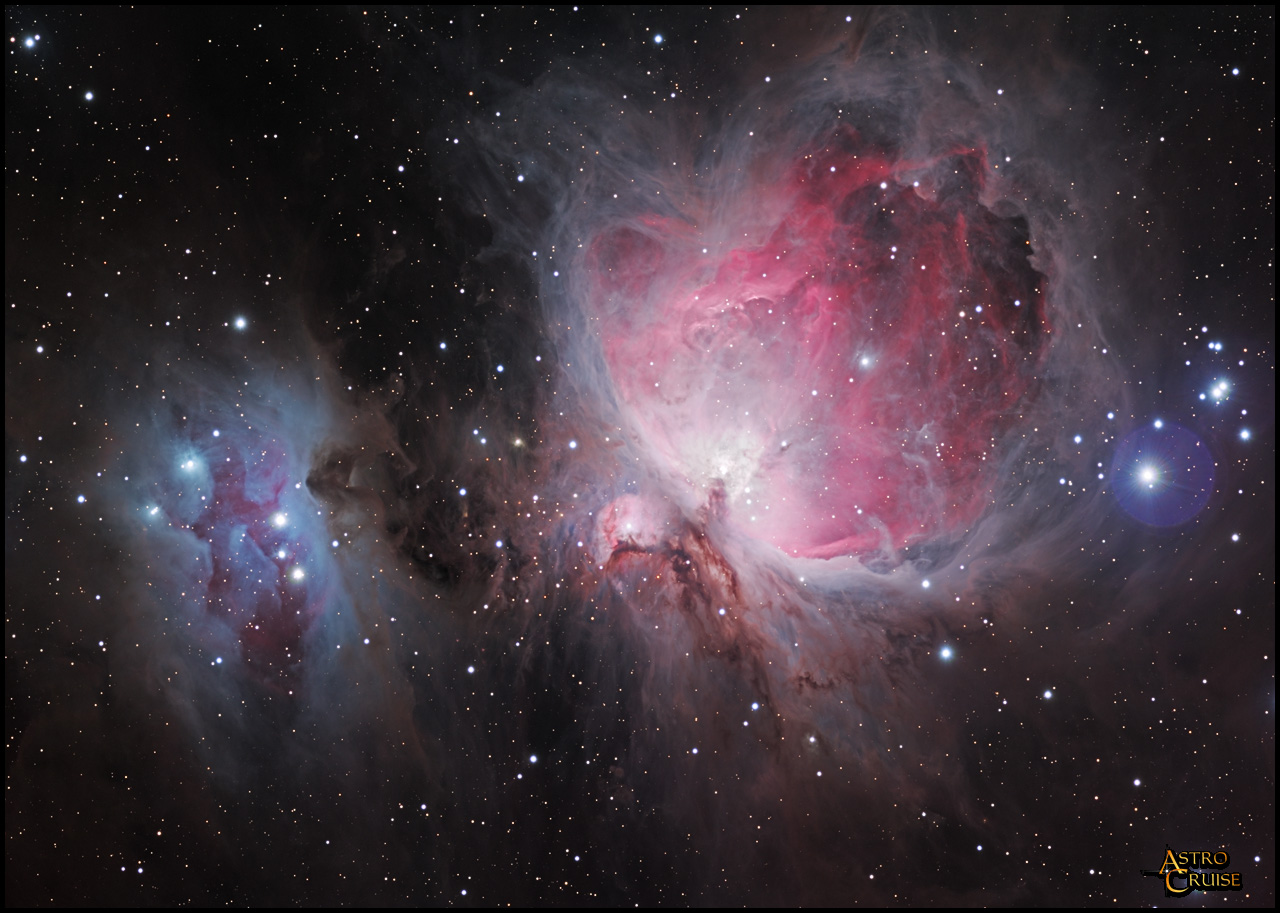
The seven most distinct stars that make up the constellation form the body and belt of Orion, who is a hunter. Something that I didn't know about Orion is that his shoulders are formed by the stars Betelgeuse (which immediately reminds me of Hitchhiker's Guide to the Galaxy) and Bellatrix (which immediately reminds me of Harry Potter). Less prominent stars form his arms and his shield (plot twist--it's not a bow like I always thought, even though I feel like a bow would make more sense for a hunter to have than a shield). Finally, two stars and the Orion Nebula form the sword that hangs down from his belt. 

The Orion Nebula, which is about 1,300 lightyears away, is one of a few nebulae that are visible to the naked eye. This formation has been greatly studied and has helped astronomers understand star formation and evolution of molecular clouds. Its core is formed by large O-class stars, which contribute a blue color to the nebula. Interestingly, a green color emitted by the nebula is caused by an electron transition in oxygen ions believed impossible for a long time. 

The Orion Nebula


Sources 
http://pages.cs.wisc.edu/~arun/orion/OrionPic.jpg
https://en.wikipedia.org/wiki/Orion_(constellation)
https://en.wikipedia.org/wiki/Orion_Nebula
http://www.astrocruise.com/milky_way/M42_0712.jpg

Week 9: An Introduction to Modern Astrophysics Ch23

This chapter of An Introduction to Modern Astrophysics covered planet formation in our solar system and beyond. It overviewed how stars and planets form, metallicities, and a brief overview on exoplanet detection, among other things. One of the topics that I thought was interesting was how the composition of planets in our solar system was determined. I knew that there are both gaseous and rocky planets in our solar system, but I didn't really know why they were ordered in the way they are or how each came to be one or the other.


The most widely accepted theory for planetary formation is that they condensed from the "leftover" material after the Sun collapsed from a cloud of gas and dust. One reason that has been proposed for why the planets are composed of different material from each other and from the Sun is that somehow a gradient formed, both in terms of the composition and the temperature of the protoplanetary disc. This meant that different materials could condense at different distances from the Sun. Jupiter, for instance, was at a distance where it was cold enough that ice particles could condense and add to the growing planet. This region was also close enough to the Sun that the protoplanetary disc was fairly dense. This allowed Jupiter to get even bigger until it was large enough to attract the lower-mass gas particles in the area, ultimately becoming the gas giant we know and love.

Another factor that played into many of our solar system's characteristics is bombardment by smaller objects. A widely accepted theory to explain the formation of our Moon is that an object about the size of Mars collided with the Earth, releasing a substantial amount material into orbit around the Earth. This material ultimately condensed and formed the Moon. Collisions can also explain why some planets (Venus and Uranus) don't rotate in the same way as all the other planets--collisions with other objects in the solar system could have altered their rotations.

The formation of our solar system even included other craziness like ejection of planetesimals from the Sun's orbit, gravitational resonance, and migration of planets inwards--but that's a story for another time.


Sources 
http://acolwell.wikispaces.com/file/view/Inner_Rocky_and_Outer_Gas_Planets.gif/538464050/Inner_Rocky_and_Outer_Gas_Planets.gif
An Introduction to Modern Astrophysics, Carroll & Ostlie 
https://en.wikipedia.org/wiki/Moon
http://www.ucolick.org/~mountain/AAA/aaawiki/doku.php?id=why_do_some_planets_have_reverse_rotation